How Does the MB Series Barmac Sand Making Machine Achieve Efficient Sand Production?
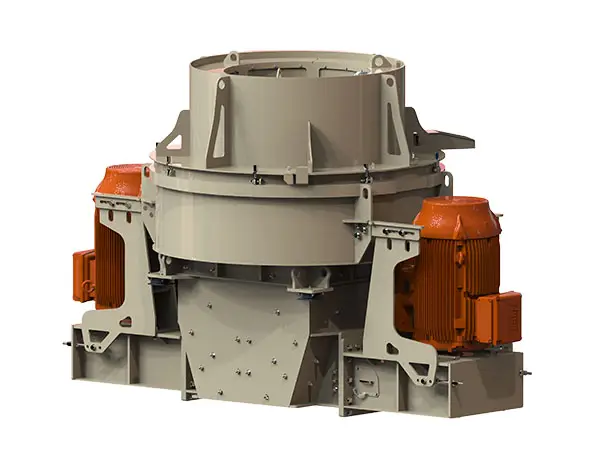
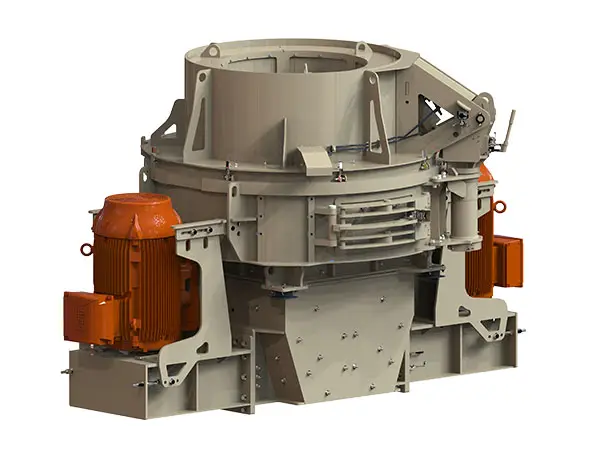
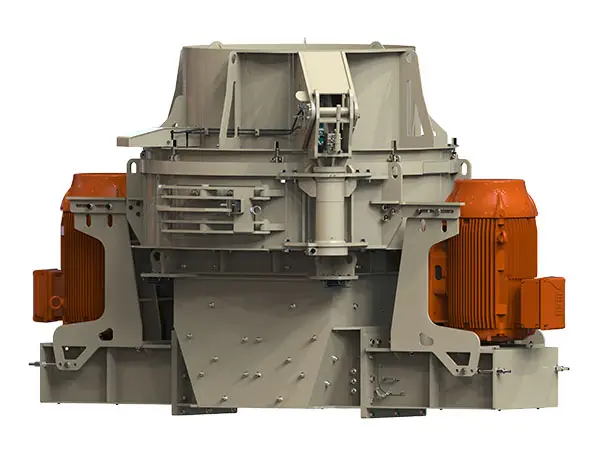
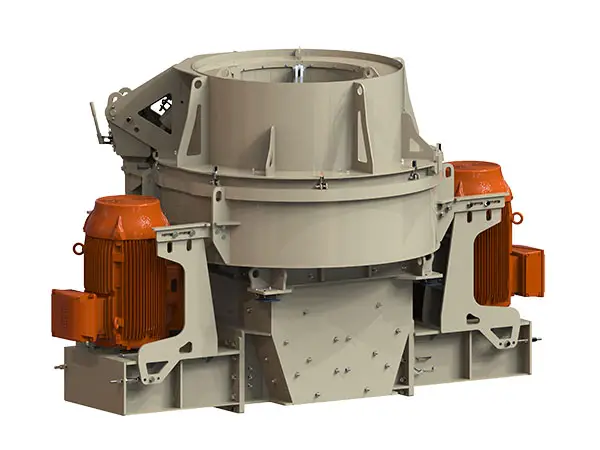
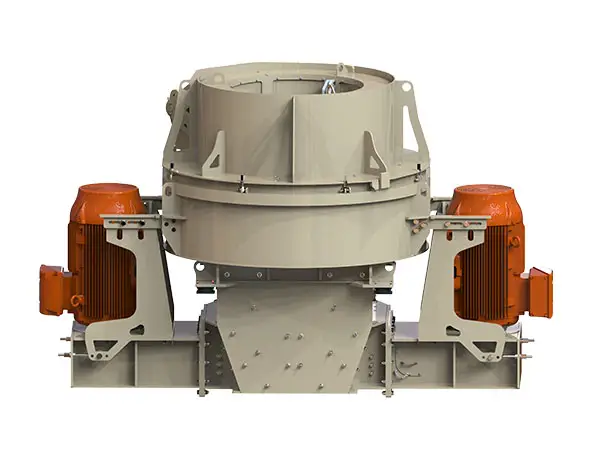
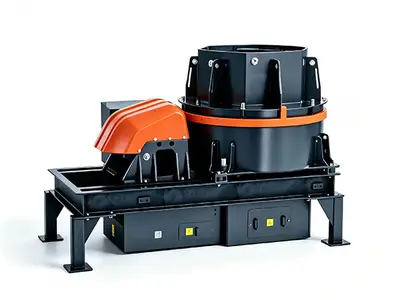
The MB series barmac sand making machine operates on the stone-on-stone crushing principle, a method that minimizes wear parts and ensures consistent product shape. Material enters through the feed hopper and is divided by a distributor: one portion enters the high-speed rotating impeller via the central feed pipe, where it is accelerated to speeds up to 75 m/s, and the other portion bypasses to the vortex crushing chamber. The high-speed material ejected from the impeller collides with the material in the vortex chamber, causing fragmentation. This interaction forms a material lining within the chamber, providing a self-lining effect that reduces wear on the equipment. The series comprises four models: MB5100SE, MB6150SE, MB7150SE, and MB9100SE, each designed to handle different feed sizes and capacities. For instance, the MB5100SE has a maximum feed size of 35 mm and a processing capacity of 37-84 T/H, while the MB9100SE handles up to 55 mm feed and delivers 375-550 T/H. The rotational speed varies from 1940 RPM for the smallest model to 1210 RPM for the largest, allowing optimization for specific applications.
This sand making machine is widely applied in industries requiring high-quality aggregates, such as construction, mining, and metallurgy. It excels in processing hard and brittle materials like river pebbles, limestone, granite, basalt, diabase, iron ore, and quartz. The stone-on-stone principle is particularly effective for abrasive materials, as it reduces wear costs compared to traditional impact crushers. The ability to handle materials with moisture content up to 8% makes it suitable for environments where wet feed is common, reducing the need for pre-drying. Additionally, the adjustable discharge particle size ensures that the finished sand meets specific grading requirements, with uniform particle size and high compressive strength. The modular hammerhead design allows for cost reduction by over 30% through replacement of worn parts only, and the secondary hammer design prevents damage to the uprights after the main hammer wears down. This makes maintenance more economical and extends the service life of the equipment.
Compared to other models in the MB series, each machine offers distinct advantages based on its size and power. The MB5100SE is ideal for small to medium-scale operations, with a single motor ranging from 75 to 132 kW and a reference weight of 6400 kg. The MB6150SE steps up with dual motors from 2×75 to 2×160 kW, handling 75-240 T/H and a maximum feed size of 45 mm. The MB7150SE provides even higher capacity, with dual motors from 2×160 to 2×250 kW, processing 200-410 T/H and accepting feed up to 50 mm. The MB9100SE is the largest, featuring dual motors from 2×280 to 2×315 kW, a processing capacity of 375-550 T/H, and a maximum feed size of 55 mm. All models share the stone-on-stone crushing principle and the ability to adjust particle size, but the larger models offer higher throughput and are suited for large-scale production. The reference weights increase with model size, from 6400 kg to 18500 kg, reflecting the robust construction required for higher capacities.
- Stone-on-stone crushing principle reduces wear parts and ensures uniform particle shape, with a self-lining effect in the vortex chamber.
- Modular hammerhead design reduces costs by over 30% through replacement of worn hammer parts only, and secondary hammer design prevents damage to uprights.
- Wide material applicability, handling soft to extremely hard materials such as river pebbles, limestone, granite, basalt, diabase, iron ore, and quartz, with moisture content up to 8%.
- Adjustable discharge particle size and both fine and coarse grinding functions, making it a multi-purpose machine for various production needs.