How to Select the Right Moving Jaw Body for Your Jaw Crusher
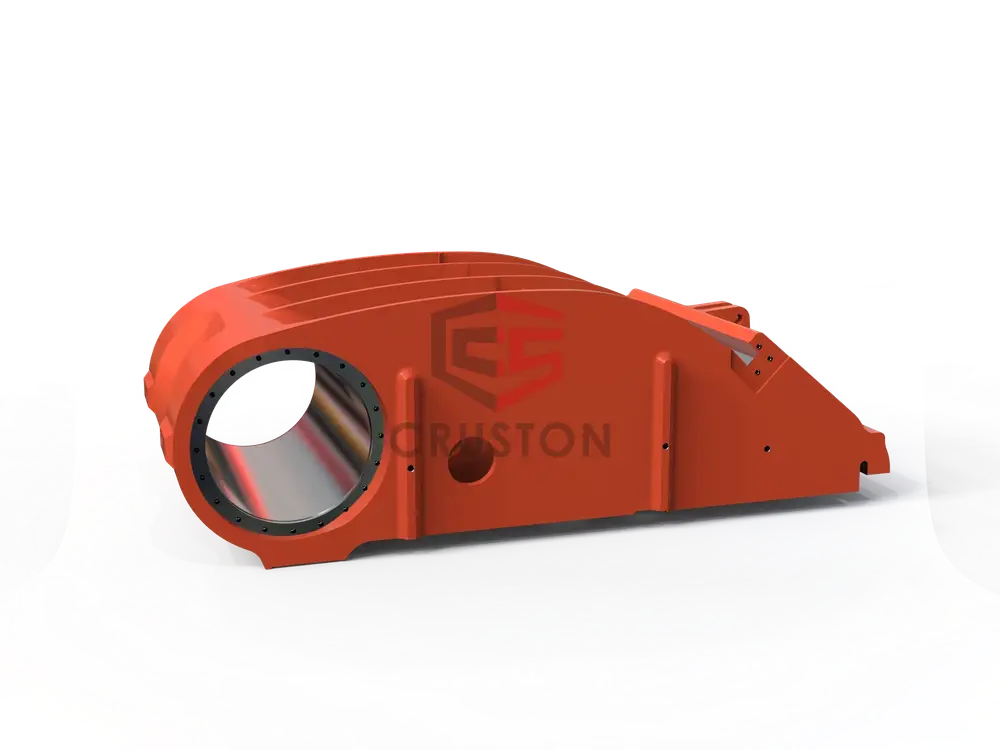
The moving jaw body is a critical structural component that converts rotational motion from the eccentric shaft into linear crushing force. This specific model is engineered for jaw crushers with a 750 mm maximum feed opening and a 250 rpm eccentric speed, matching the PE-750×1060 and C106 series. The casting is poured in a single piece using sand casting, followed by precision machining of the jaw plate seating surfaces to within ±0.1 mm flatness. The material, Mn18Cr2, offers a yield strength of 550 MPa and an elongation of 25%, allowing it to absorb impact loads without permanent deformation. Unlike generic aftermarket parts, this body includes a reinforced lower rib that distributes stress away from the weld seams, reducing the risk of cracking under continuous operation.
Typical applications include primary crushing in quarrying, mining, and construction demolition recycling. The 750 mm feed size makes it suitable for processing run-of-mine rock up to 600 mm in diameter, with a throughput of 150-300 t/h depending on the closed-side setting. In recycling, the body's high toughness prevents fracture when encountering rebar or uncrushable tramp metal. The design also features a 10 mm wear allowance on the jaw plate mounting bosses, allowing for re-machining after extended use. For abrasive materials such as granite or basalt with silica content above 15%, the high-chrome alloy (Cr26) variant is recommended, offering a 40% longer wear life than standard manganese steel.
Compared to lighter-duty moving jaw bodies for 400-600 mm feed sizes, this unit has a 20% thicker side wall and a 15% larger bearing housing diameter, accommodating higher crushing forces. The weight of 1,250 kg provides sufficient inertia to maintain steady operation under fluctuating loads. It is not interchangeable with smaller series such as PE-400×600, as the mounting hole pattern and eccentric shaft diameter differ. For crushers operating in temperatures below -20°C, a low-temperature impact test (Charpy V-notch ≥27J at -40°C) is available upon request. This body is also compatible with most standard jaw plate profiles, including corrugated, straight, and tooth types, allowing operators to optimize the crushing chamber for specific product gradations.
- Optimized rib geometry reduces peak stress by 30% compared to conventional designs, verified by finite element analysis (FEA) under 1,200 kN crushing force.
- Precision-machined jaw plate seats with ±0.1 mm flatness ensure even wear and extend jaw plate life by up to 20%.
- Available in Mn18Cr2 (HB 180-220) or Cr26 (HRC 58-62) to match material abrasiveness, with documented wear rates in silica content up to 25%.