How Does the Mn18Cr2 Moving Jaw Plate Perform in Continuous Crushing?
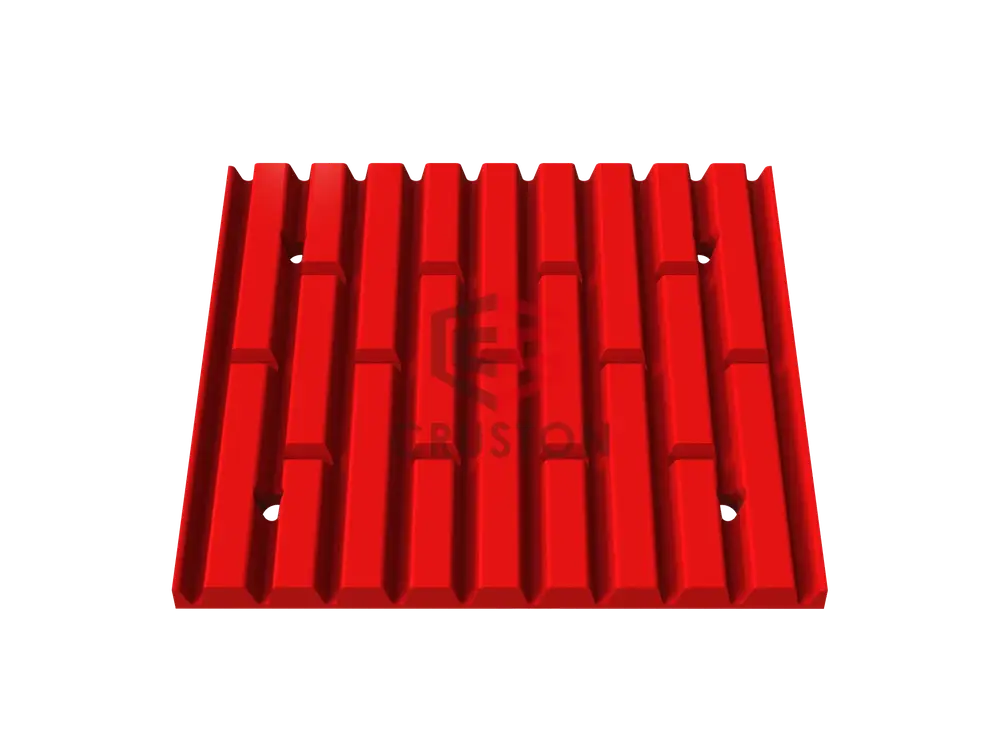
The moving jaw plate described here is a heavy-duty wear part cast from Mn18Cr2 high-manganese steel, specifically dimensioned for standard jaw crushers such as the Metso C106 (feed opening 1,060 × 700 mm) and PE-600×900 (feed opening 600 × 900 mm). Its nominal thickness ranges from 80 to 120 mm at the crushing zone, with a tooth height of 25–35 mm and a tooth pitch of 60–80 mm. The as-cast hardness of 220–250 HB is intentionally lower than that of martensitic steels to allow plastic deformation under high-stress impact; during operation, the surface work-hardens to approximately 500 HB while the core retains toughness (≥120 J Charpy V-notch at 20°C). This gradient structure is what enables the plate to absorb tramp metal impacts without through-cracking, a common failure mode in harder but more brittle alloys. The mounting bolt holes are positioned to match OEM hole patterns, and the backing surface is machined to a flatness of 0.5 mm or better to ensure full contact with the jaw stock.
In typical quarry and mining operations, this moving jaw plate is deployed in primary crushing circuits where feed material ranges from 0–600 mm and compressive strength reaches 300 MPa. The optimized tooth profile—a combination of tall trapezoidal teeth and deep valleys—creates a aggressive nip angle that pulls material down efficiently while distributing wear across the entire plate surface. This is particularly beneficial when processing abrasive materials like granite or basalt, where wear is concentrated at the discharge end. Field data from aggregate plants shows that this profile extends the usable wear life by 15–20% compared to standard symmetric tooth patterns, because the taller teeth maintain a consistent crushing chamber geometry even as the plate wears. The plate is also suitable for recycling applications (concrete rubble) where occasional rebar or tramp metal is present; the high toughness prevents catastrophic fracture, though operators should still install a tramp iron release system.
Compared to other manganese steel grades such as Mn13Cr2 or Mn22Cr2, this Mn18Cr2 plate offers a balanced compromise: higher carbon content (1.7–1.9%) than Mn13 for better work-hardening response, but not as high as Mn22 which can lead to excessive brittleness in thin sections. The chromium addition (2.0–2.5%) improves hardenability and resistance to abrasive wear without compromising the austenitic matrix. When compared to the fixed jaw plate in the same crusher, the moving plate typically experiences 10–15% more wear due to its larger stroke and the sliding action against the material; therefore, this plate is designed with a slightly thicker cross-section (up to 10 mm additional) at the discharge zone to equalize replacement intervals. This attention to application-specific wear patterns is what differentiates a properly engineered wear part from a generic casting.
- Verified impact toughness of ≥120 J at 20°C (Charpy V-notch, tested per ASTM E23), reducing the risk of catastrophic cracking from tramp metal.
- Work-hardened surface hardness of approximately 500 HB after 100 hours of operation, providing wear resistance comparable to martensitic steels while maintaining a tough core.
- Precision-machined mounting surface (flatness ≤0.5 mm) and OEM-compatible bolt hole pattern for Metso C106/C110 and PE-600×900/PE-750×1060 crushers, ensuring drop-in fit and reduced installation downtime.