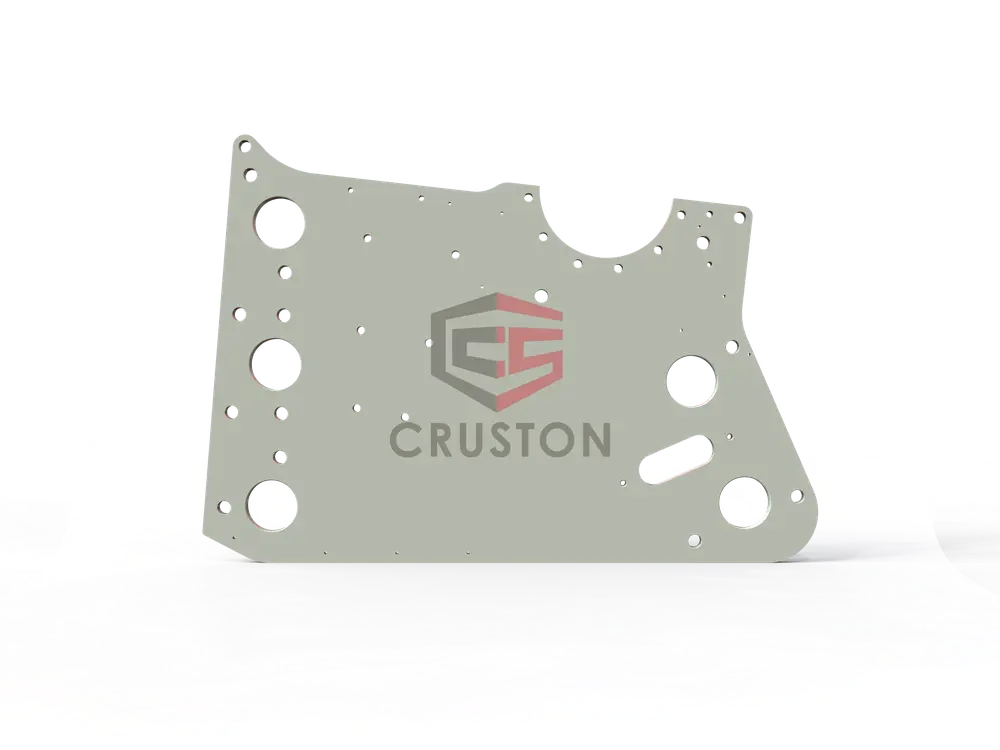
Side wall panel

Side Wall Panel

50mm Insulated Side Wall Panel for Modular Enclosures and Cold Storage

This side wall panel is a 50mm thick sandwich panel engineered for modular enclosures, cold storage rooms, and industrial partitions. It combines 0.5mm pre-painted steel skins with a 40kg/m³ polyisocyanurate (PIR) foam core, delivering an R-value of 3.5 m²·K/W and Class B fire performance to EN 13501-1.

Panel Thickness
50mm
Internal Skin Material
0.5mm galvanized steel
Core Insulation
Polyisocyanurate (PIR) foam, 40kg/m³ density
Thermal Resistance (R-value)
3.5 m²·K/W

How Does the 50mm Side Wall Panel Perform in Cold Storage and Modular Enclosure Applications?

The 50mm side wall panel is a structural insulated panel built around a polyisocyanurate (PIR) foam core with a density of 40kg/m³. Both faces are 0.5mm steel: the external skin is pre-painted with a 25μm polyester coating, while the internal skin is hot-dip galvanized to Z275 specification. The panel achieves a thermal resistance (R-value) of 3.5 m²·K/W, which translates to a U-value of approximately 0.29 W/m²·K. Fire performance is rated Class B according to EN 13501-1, with a smoke production rating of s1 and flaming droplet rating of d0. The tongue-and-groove edge profile includes a factory-applied EPDM gasket that compresses to 30% of its original thickness during assembly, creating an airtight seal without additional sealants. Panel weight is 10.5 kg/m², allowing two workers to handle standard 1.2m x 2.4m panels manually.

In cold storage construction, this panel is typically used for walls of walk-in freezers and chillers operating between -25°C and +5°C. The PIR core's closed-cell structure (over 90% closed cells) resists moisture ingress, preventing the insulation degradation that plagues EPS-core panels in high-humidity environments. For modular enclosures housing generators or electrical equipment, the galvanized internal skin provides EMI shielding when bonded to earth, and the pre-painted external skin withstands UV exposure without chalking for up to 10 years. The panel's compressive strength of 150 kPa (at 10% deformation) allows it to support ceiling panels and light fixtures without additional framing. Installation requires only a hex key and a rubber mallet; a 20m² wall can be assembled by two workers in under four hours.

Compared to 75mm or 100mm panels in the same series, this 50mm variant offers a 33% weight reduction and 40% lower material cost while maintaining sufficient insulation for moderate-temperature applications (above -25°C). It is not recommended for blast-freezer walls (below -30°C) where 100mm panels are required to prevent surface condensation. However, for temperature-controlled warehouses, cleanrooms, and acoustic partitions, the 50mm panel delivers the best balance of thermal performance and structural economy. The panel's slim profile also maximizes interior floor space—a critical factor in urban cold storage where rent is calculated per cubic meter.

  • Thermal performance: R-value 3.5 m²·K/W, U-value 0.29 W/m²·K, verified by guarded hot box test per ASTM C1363.
  • Fire safety: Class B-s1,d0 to EN 13501-1, with PIR core achieving a limiting oxygen index (LOI) of 26% per ASTM D2863.
  • Structural integrity: Compressive strength 150 kPa, shear strength 120 kPa, and point load capacity of 1.5 kN over a 100mm x 100mm area without permanent deformation.

Core Technical Characteristics and Quantified Advantages

STEP 1

PIR Foam Core with 40kg/m³ Density and 90% Closed Cells

The polyisocyanurate core is produced in a continuous lamination process, achieving a uniform density of 40kg/m³ and a closed-cell content exceeding 90% per ASTM D6226. This structure yields a thermal conductivity of 0.023 W/m·K at 10°C mean temperature, which is 15% lower than typical EPS cores. The closed cells also resist water vapor transmission, with a permeance of 1.2 ng/(Pa·s·m²) per EN 12086, preventing insulation degradation in humid cold-storage environments.

STEP 2

0.5mm Pre-Painted Steel Skins with 25μm Polyester Coating

Both panel faces use 0.5mm thick steel: the external skin is pre-painted with a 25μm polyester coating over a 5μm primer, providing color stability and corrosion resistance. The internal skin is hot-dip galvanized to Z275 (275g/m² zinc coating), which offers sacrificial protection at cut edges. Salt spray testing per ASTM B117 shows no red rust after 500 hours on the external surface. The steel skins are bonded to the PIR core with a two-component polyurethane adhesive that achieves a peel strength of 120 N/50mm.

STEP 3

Tongue-and-Groove Joint with EPDM Gasket for Airtight Assembly

Each panel edge features a precision-milled tongue-and-groove profile with a factory-installed EPDM gasket. During assembly, the gasket compresses by 30% to fill tolerances up to ±2mm, creating an airtight seal that meets EN 12207 Class 4 air permeability. The joint also includes a concealed fixing channel that accepts M6 screws, allowing panels to be locked together without visible fasteners on the interior face. This design reduces thermal bridging: the joint's linear thermal transmittance is 0.05 W/m·K, compared to 0.12 W/m·K for simple butt joints.

STEP 4

Class B-s1,d0 Fire Performance to EN 13501-1

The complete panel assembly has been tested to EN 13823 (SBI test) and achieves Class B-s1,d0: limited contribution to fire, minimal smoke production (s1), and no flaming droplets (d0). The PIR core has a limiting oxygen index of 26% per ASTM D2863, meaning it requires at least 26% oxygen to sustain combustion. This performance makes the panel suitable for enclosed spaces where evacuation time is critical, such as modular offices and cleanrooms. The panel's fire rating is maintained even when cut to size, as the exposed core chars to form a protective layer.

FAQs about Side Wall Panel

Similar Models