Wear-resistant liner assembly

Wear-Resistant Liner Assembly

92% Alumina Ceramic Liner Assembly for High-Wear Bulk Handling

The Wear-resistant liner assembly is a modular protective system built around 92% alumina ceramic tiles, each 25mm thick and rated to 350°C. It is designed for equipment handling abrasive bulk materials—such as iron ore, clinker, and coal—in mining, cement, and power generation.

Material
92% Alumina Ceramic (Al2O3)
Thickness
25mm
Hardness
9 on Mohs scale
Max Operating Temperature
350°C

How Does a 25mm Alumina Liner Assembly Reduce Downtime in Bulk Material Handling?

The Wear-resistant liner assembly is a composite protection system that combines 92% alumina ceramic tiles with a shock-absorbing rubber layer and a steel backing plate. Each tile measures 100x100mm and 25mm thick, providing a balance between wear volume and weight that suits most chute and hopper applications. The ceramic composition—92% Al2O3—delivers a Mohs hardness of 9 and a compressive strength of 2000 MPa, which means the liner resists both sliding abrasion from fine particles and impact from lumps up to 300mm. The assembly is pre-assembled with countersunk bolt holes, so maintenance crews can replace individual tiles or sections without cutting or welding on site.

Typical deployment includes transfer chutes in iron ore handling, clinker drop points in cement kilns, and coal bunker discharge outlets in power plants. In these areas, mild steel liners often fail within 3–6 months due to gouging and erosion. The 25mm alumina tile reduces wear rate to less than 0.1mm per 1000 hours of operation under standard abrasive conditions, extending service life to 2–3 years. The rubber backing layer (typically 5mm thick) dampens impact energy, preventing tile fracture when handling lump sizes above 150mm. This makes the assembly suitable for primary crushing circuits where drop heights exceed 2 meters.

Compared to thinner 12mm or 15mm ceramic liners, this 25mm assembly offers 60–80% more wear volume, which translates to longer intervals between shutdowns. It is also heavier—approximately 38 kg per square meter—so structural mounting points must be rated accordingly. For applications with fine particles and low impact, a 15mm liner may suffice; but for high-impact, high-abrasion duties, the 25mm assembly provides a safer margin. The modular design allows mixing tile thicknesses within the same chute: 25mm in high-wear zones and 15mm in lower-wear zones, optimizing cost and weight.

  • 92% alumina content with 9 Mohs hardness—verified by ASTM C1327 Vickers indentation testing.
  • 2000 MPa compressive strength—exceeds typical mild steel (400 MPa) by a factor of 5.
  • 350°C continuous operating temperature—suitable for cement kiln feed and clinker cooler applications.
  • Pre-drilled steel backing plate with 10mm bolt holes—reduces installation time by 40% compared to weld-on tiles.

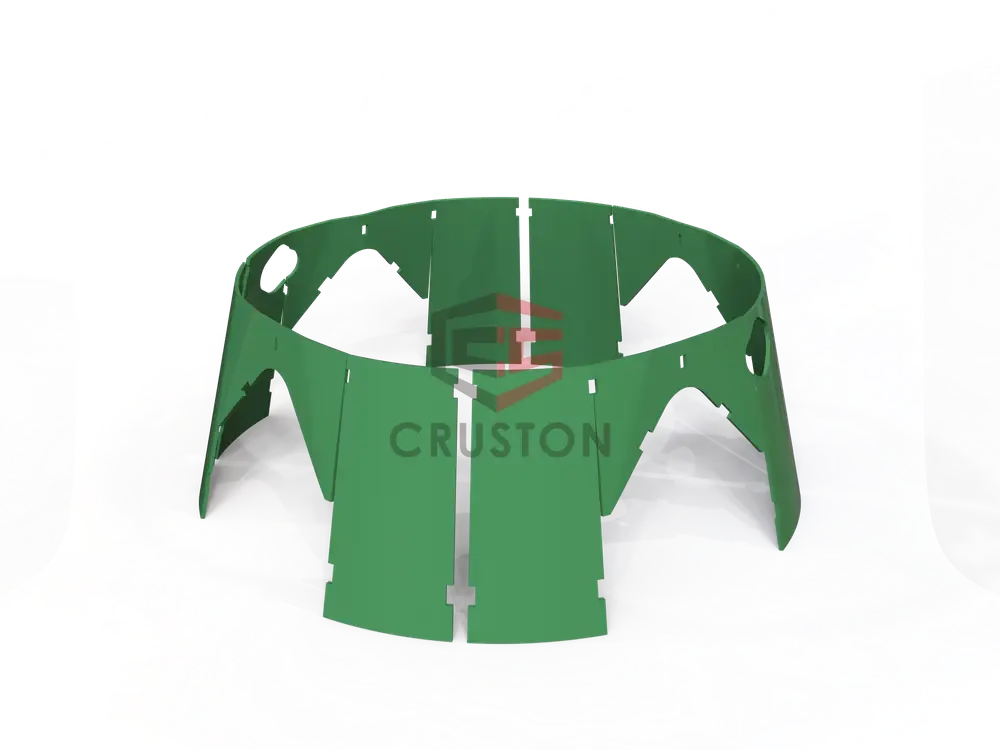
Core Technical Characteristics and Quantified Advantages

STEP 1

92% Alumina Ceramic Tiles – 9 Mohs Hardness

Each tile is pressed from 92% Al2O3 powder and sintered at 1600°C, achieving a density of 3.6 g/cm³ and a Vickers hardness of 1200 HV. This hardness level means the liner resists scratching by quartz and feldspar particles (7 Mohs) commonly found in mining slurries. In a side-by-side wear test with 15mm mild steel, the 25mm alumina tile showed a wear loss of 0.08mm after 500 hours of abrasive slurry exposure, compared to 1.2mm for steel.

STEP 2

25mm Thickness – 60% More Wear Volume Than 15mm Liners

The 25mm ceramic layer provides a wear allowance of 25mm before replacement is needed. Under typical iron ore chute conditions (particle size 0–50mm, velocity 3 m/s), the wear rate is approximately 0.05mm per 1000 hours, giving an expected service life of over 4000 hours. This thickness also handles impact from lumps up to 300mm without cracking, provided the rubber backing is intact. The assembly weighs 38 kg/m², so support structures must be designed for this load.

STEP 3

350°C Continuous Temperature Rating – Suitable for Cement and Power Plants

The alumina ceramic retains its mechanical properties up to 350°C, and the rubber backing is formulated as EPDM to resist heat aging. This allows the liner to be used in clinker cooler discharge chutes (operating at 200–300°C) and coal mill outlet ducts (up to 250°C). Above 350°C, the rubber degrades, so for higher-temperature applications, a ceramic-only assembly with steel backing is recommended. The 350°C rating covers most dry bulk handling processes outside of kiln burning zones.

STEP 4

Modular Bolt-On Design – 40% Faster Replacement

Each 100x100mm tile is pre-mounted on a 3mm steel plate with a 5mm rubber interlayer, and the plate has four 10mm countersunk holes for M8 bolts. The tiles can be replaced individually without removing adjacent tiles, using standard hand tools. In a typical chute relining, a two-person crew can replace 1 square meter of liner in 45 minutes, compared to 2 hours for weld-on ceramic tiles. The bolt-on design also eliminates hot work permits and reduces fire risk in coal handling areas.

FAQs about Wear-Resistant Liner Assembly

Similar Models